Showing posts with label dpdtswitch. Show all posts

Sunday, September 27, 2020

Vintage Hofner 173 Reboot | Part 3

Part 1 | Part 2 | Part 3 | Part 4 | Part 5

Electronics

So far, we've looked at the External Features and Hardware of this vintage sunburst Hofner 173 electric guitar. Now it's time to evaluate the electronics. Underneath the pickguard lies a maze of cruddy wiring, which takes quite a while to figure out. 

I'm glad to say that I've finally determined what's connected to what; and what it is that I'm looking at. And if you click the last picture of this post, you'll see a circuit diagram of sorts; courtesy of yours truly and MS Paint.

The set up is basically three H513 single-coil pickups wired to a trio of DPDT ON/OFF slide switches. Up is OFF, and down is ON. Did I say "single-coil"? Yes, I did. There's only one coil, wrapped around the blade. The faux "polepiece" screws don't have anything wrapped around them at all.

It's intriguing indeed; but way beyond my level of expertise. So we'll leave it at that. In any case, you'd be able to get two more sounds than say; a stock Fender Strat. I mean, imagine the how cool it would be to pair the Neck and Bridge pickups, or all three together? Yes, this Hofner 173 would be able to do just that; were it in working condition.

From the switch unit, the signal from each pickup is fed to a dedicated 100K Log (Audio Taper) pot; hooked up to a 0.033uF ITT MPT-1 tone cap. After passing through the Tone pots, the signal ends up at a 220K Lin (Linear Taper) Master Volume pot; which controls the output to the mono jack socket.

The DPDT switches are still functioning, but the same cannot be said for the pots or jack socket. These would have to be replaced, should the owner decide to proceed with repairs. Meanwhile, the only working pickup is the Neck (Bass). The DCR reading is a healthy 7.14K. Poor Discant (Middle) and Treble (Bridge) have gone open circuit; it would seem. 

I actually opened up the Treble (Bridge) pickup, and measured the DCR off the coil itself; but to no avail ~ it was most certainly shorted out or broken deep within. On the plus side, at least I got to examine the innards of an H513 and confirm that these babies are indeed single-coils. With that, I bid you adieu. Thanks for visiting, and I'll see you again soon. Stay safe, stay healthy, and God bless :)


Hofner 173 Wiring Diagram
 

Thursday, September 24, 2020

OLP MM1F Restoration: Part Two

Quick Links: Part One | Part Two | Part Three

In the previous post, we took a brief look at what needed to be done in order to restore this OLP MM1F to gigging condition. And so, this post outlines just that. We'll begin with the pickups, then. A brand new DiMarzio DP151 PAF Pro® (neck) and DP155 The Tone Zone® (bridge) were wired in; coil splitting enabled by an NKK (Japan) DPDT switch. 

Complementing the upgrade were an Alpha A500K pot, three-way toggle switch; and Neutrik/Rean NYS229 output jack. Gavitt® single conductor braided shield cable was used for the master volume-output jack run. Other repairs/enhancements included a thorough cleaning and lube job for the hardware and Floyd Rose-licensed trem, a new "football" jack plate, hole plugging and sealing, fret dressing; and additional trem spring.


OLP MM1F Restoration: Part One

Related Posts 
Part One | Part Two | Part Three

Howdy folks :) This post is the first of three regarding the restoration of an OLP MM1F electric guitar. Now, according to Reverb, the OLP MM1F features a "basswood body, maple neck, jumbo frets, sealed die-cast tuners, Floyd Rose-licensed tremolo, dual humbuckers, single volume knob, 3-way switch, maple fretboard; and chrome hardware." I'd like to add that truss rod adjustment is at the heel, via a "spoke wheel" nut.

Which brings us to this particular MM1F. The owner says that it had been put aside for nearly ten years and was now in a sorry state. However, as he was planning to gig again; he needed the guitar back in shape as soon as possible. A previous owner had swapped the stock "zebra" humbuckers for a pair of DiMarzios: a DP151 PAF Pro® (neck) and DP155 The Tone Zone® (bridge). He'd also wired in a DPDT toggle switch for coil splitting.

There was lots that needed to be replaced and/or fixed on this guitar. For example, the electronics were badly corroded and basically unusable. Then there was the Floyd Rose-licensed trem ~ both pivot posts were in danger of disintegrating! Besides this, the frets needed to be leveled and recrowned (fret dressing). 

There was also a gaping hole on the top horn, marking the spot where the strap button had originally been. Perhaps the saddest discovery was that only one coil of the DP151 PAF Pro® was functioning; while both coils of the DP155 The Tone Zone® were dead and buried. Well, certainly time for new pickups. That's it for this post. Thanks for checking in. Stay safe, stay healthy; and I'll see you soon :)


Tuesday, March 06, 2012

Washburn XB125 Phat II Mod Wiring Diagram


Washburn XB125 Phat II Mod Wiring Diagram

Washburn XB125 Phat II Mod


Guess what? Rizal has scored a Phat II EQ circuit board off an old Ibanez bass, and has asked me to install it in his XB125. To date, I've completed control cavity shielding and tested the new wiring scheme. Everything is working as it should, thank goodness. This new scheme comprises the following:

  • Phat II EQ Board
  • 9V Battery
  • Alpha 500K Master Volume Pot
  • Alpha 500K Master Tone Pot
  • 0.047uF Tone Cap
  • Three-Way Toggle Switch (Neck/Both/Bridge)
  • DPDT Bypass Switch
  • Stereo Output Jack


Battery compartment and control cavity.

Closer view of the control cavity.

New layout for the controls.

Friday, February 24, 2012

Washburn XB125 Stopgap Wiring Mod

Related Posts

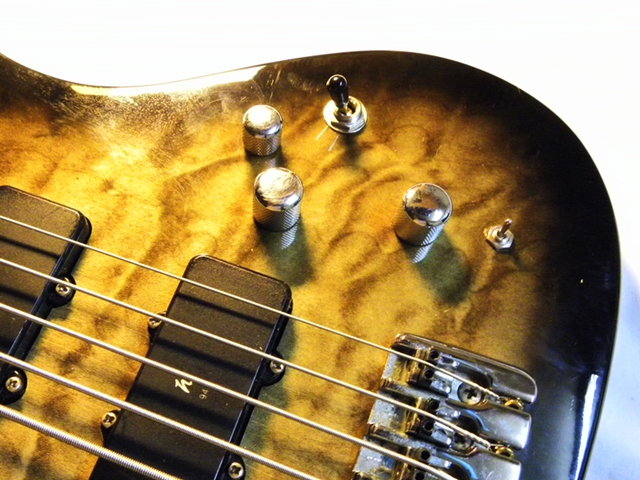
Here's a "Crafted in China" Washburn XB125, the main squeeze of Orkestra JPN Pahang bassist Rizal Efendi. It originally had active electronics, but that died long ago and all that remains is an empty 9V battery compartment. Currently, it is fully passive, with a modified control configuration of master volume, master tone and three-way pickup selector toggle switch. 

Now, the bad news. The toggle switch stubbornly refuses to function, the bass produces no sound, Rizal has an upcoming gig, and none of the local music stores have toggle switches in stock. As the XB125 is his only bass, I need to come up with a solution in double-quick time. 

Here's what I did - I desoldered the faulty toggle switch and wired in a DiMarzio 500K pot that happened to be in my spare parts bin. So, what you are looking at below is an adequately functioning Washburn XB125 with a neck pickup volume control, bridge pickup volume control and DiMarzio 500K master tone control. Necessity is the mother of invention!


Layout of Controls


The nut appears to be made of wood.

W941 (neck) and W943 (bridge) pickups.

Pickups potted with epoxy